
Rheinmetall wins major order for ‘Jackal’ combat vehicles
First Caracal series-production vehicles delivered; Rheinmetall and Silvus Technologies strengthen airspace security
By APDR
•Nov 2, 2026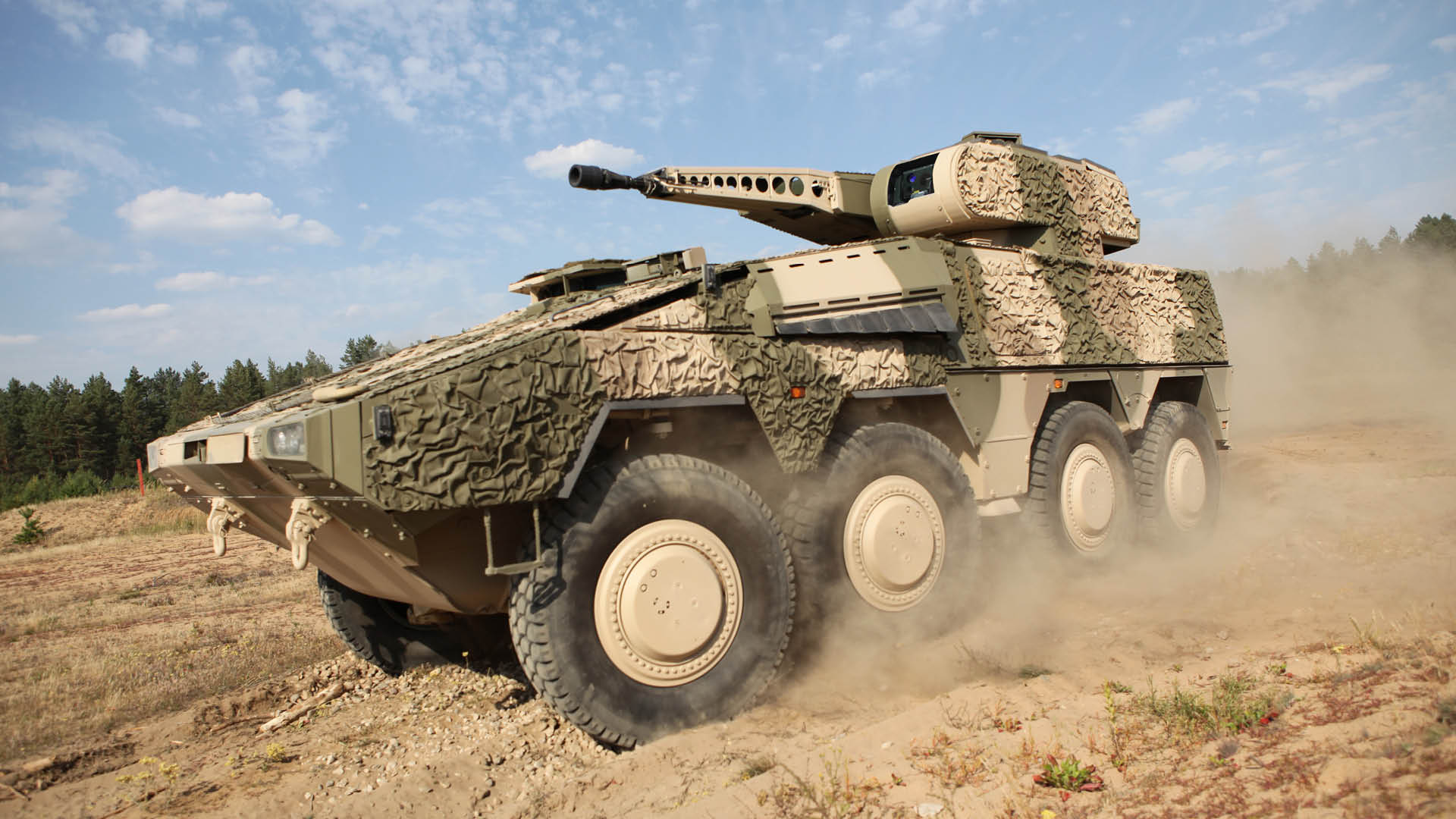
Rheinmetall has once again received a major order in the field of 8×8 combat vehicles. The European defence organisation OCCAR (Organisation Conjointe de Coopération en Matière d’Armement) has commissioned Artec GmbH to deliver further Schakal (German for “jackal”) wheeled infantry fighting vehicles to the German and Dutch armed forces: 35 for the Bundeswehr and 34 for the Royal Dutch Land Forces. Artec GmbH, a joint venture between Rheinmetall and KNDS Deutschland, is the prime contractor for the Boxer. As a key industrial partner, Rheinmetall is making a significant contribution to the programme’s implementation. For the Düsseldorf-based technology group, the two option call-offs have a combined order value in the medium three-digit million-euro range. According to current plans, the vehicles are to be delivered between May 2032 and November 2033. On 24 June 2026, the Budget Committee of the German Parliament, the Bundestag, approved the first call-off of the contractually agreed options for the Schakal. The main contract, which was awarded in October 2025, already covers 222 wheeled infantry fighting vehicles and includes an option for up to 200 additional vehicles. Following this initial option call-off, the total number of Schakal vehicles to be delivered will increase to 291. “The activation of additional options for the Schakal confirms our customers’ confidence in this state-of-the-art system”, said Dr Björn Bernhard, Head of Rheinmetall’s Vehicle Systems Division. “It also gives us greater insurance for us as an industry and for our suppliers concerning the planning. Together with our partners, we are contribution significantly to the modernisation of European land forces and are strengthening industrial capacity in Europe”. The Schakal wheeled infantry fighting vehicle combines the chassis of the Boxer wheeled armoured vehicle with the turret of the tracked Puma infantry fighting vehicle. It thus combines modularity, mobility, protection and firepower to the highest degree. This enables medium forces to cover long distances independently in the shortest possible time. The system features state-of-the-art fire control technology, digital networking and a high level of protection, and can carry a fully equipped group of grenadiers. Its main weapon system is the MK 30-2/ABM machine gun, manufactured by Rheinmetall. This is complemented by the MELLS anti-tank guided missile. Together, these provide adequate fire power against a wide variety of targets in dynamic combat situations. As the Schakal is part of the Boxer family, training, logistics and lifecycle costs are reduced. The German-Dutch OCCAR programme highlights the effectiveness of European defence cooperation and strengthens the European defence industry against foreign competition in the 8×8 vehicle sector. This is also beneficial for the German land systems industry. Key assemblies and components are produced at sites in Germany, operated by Rheinmetall, KNDS Deutschland, MTU, Hensoldt and many other small and medium-sized champions in the national defence sector. The programme strengthens the industrial base and secures highly skilled jobs in the long term. Should the large-scale ‘Arminius’ Boxer programme be commissioned, German industry has guaranteed a significantly accelerated delivery of the vehicles, which are ordered as an option. First Caracal series-production vehicles delivered (PHOTO: Rheinmetall) Rheinmetall has delivered the first Caracal series-production vehicles to the German and Dutch armed forces. During a formal ceremony on 29th October 2026 at the Dutch production site in Ede, Rheinmetall Landsysteme GmbH and Rheinmetall Defence Nederland B.V. handed over the first production vehicles to the Federal Office of Bundeswehr Equipment, Information Technology and In-Service Support (BAAINBw) and to the Dutch Ministry of Defence. The latter had already received the first vehicle for the drivers’ training on 29 September 2026. The delivery of the first series-production vehicles of the Caracal – the military designation being “Einsatzsystem Luftlandeplattform” (Deployment System Airmobile Platform) – marks an important milestone in the project’s progress. This is the foundation for the delivery of further vehicles, which offer an impressive variety of roles, with a current total of 28 different equipment kits. The contract not only covers the delivery of the vehicles but also full life-cycle support over 20 years, thus providing a long, sustainable service life. A total of more than 1,500 vehicles will be delivered by 2030 to the German Bundeswehr and the Dutch Armed Forces. The Caracal is a modular, multipurpose, highly mobile vehicle. It is built on the latest-generation Mercedes-Benz G-Class (464 model series) military production chassis, which is also used for the Wolf 2. Its lightweight, modular superstructure is manufactured to suit its specific role. Final assembly of the vehicle will take place at Rheinmetall Defence Nederland’s production site in Ede, the Netherlands. The Caracal provides the Bundeswehr and the Dutch armed forces with a tactical vehicle that significantly improves the mobility of airborne forces. In its basic configuration, the Caracal can accommodate four soldiers, alongside their personal and mission-specific equipment. Rheinmetall and Silvus Technologies strengthen airspace security (IMAGE: Rheinmetall) Rheinmetall Air Defence AG has entered into an agreement with Silvus Technologies, a leading innovator in radio frequency (RF) technology, to integrate its passive RF sensors into Rheinmetall’s ground-based air defence systems. The sensors provide a new layer of passive threat detection in Rheinmetall’s Skynex Air Defence System and Skymaster command and control platform by exploiting electromagnetic spectrum to enhance resilience and early threat awareness. “Modern airspace is becoming more congested and more difficult to monitor, driven by the proliferation of unmanned aircraft and hard-to-detect aerial technologies,” said Roman Köhne, CEO, Rheinmetall Air Defence AG. “Traditional detection methods alone can struggle with identifying new and novel threats in complex operating conditions. Integrating passive RF sensing into Skymaster enhances air defenders’ ability to respond effectively to emerging aerial threats.” Silvus Technologies’ RFeye sensors provide a complementary layer of passive detection to identify and locate aerial platforms without actively transmitting or revealing the sensors’ locations. Within the Skymaster platform, they supplement radar coverage by helping operators maintain a more complete, persistent air picture and recognized electromagnetic picture (REMP). “The agreement reflects a shared commitment to delivering resilient air defence systems for allied forces,” said Peter Moss, director of strategic NATO accounts, Silvus Technologies. “Combining RFeye technology and Rheinmetall’s air defence architecture gives operators critical situational awareness to inform quicker actions and safer decisions.” For Editorial Inquiries Contact: Editor Kym Bergmann at [email protected] For Advertising Inquiries Contact: Group Sales Director Simon Hadfield at [email protected]

Comments
Loading comments...